



Osteopathy prioritizes your physical well-being, fostering mobility, pain relief, vitality, and overall happiness in Mississauga.
About Mississauga Osteopathy
Our clinic provides Excellent Osteopathy Service in Mississauga, supporting individuals who experience musculoskeletal conditions such as shoulder impingement. We focus on understanding how joint alignment, muscle balance, and everyday movement patterns influence pain and mobility.
Our approach emphasizes careful assessment, hands-on treatment, and guidance on posture, movement, and rehabilitation exercises. By addressing the underlying causes of shoulder strain and dysfunction, we aim to help restore comfortable movement and promote long-term joint health.

Top-Rated Mississauga Osteopathic Manual Practitioners
Shoulder impingement is a common condition that can cause persistent shoulder discomfort and limit normal arm movement. The shoulder joint is a remarkably complex structure. Its design allows an exceptional range of motion, yet it naturally sacrifices some stability. When all parts of the joint work together properly, the shoulder moves smoothly and without pain. However, when irritation develops within the tissues of the joint, movement can become painful and restricted.
Many people describe any form of shoulder pain as bursitis. In reality, bursitis refers specifically to inflammation of a structure known as the bursa, a small fluid-filled sac that reduces friction between tissues. Tendonitis, on the other hand, occurs when a tendon becomes inflamed. Both bursitis and tendonitis may contribute to shoulder pain, but another common cause is shoulder impingement syndrome. This condition develops when the tendons of the rotator cuff rub against the upper part of the shoulder blade known as the acromion.
Anatomy
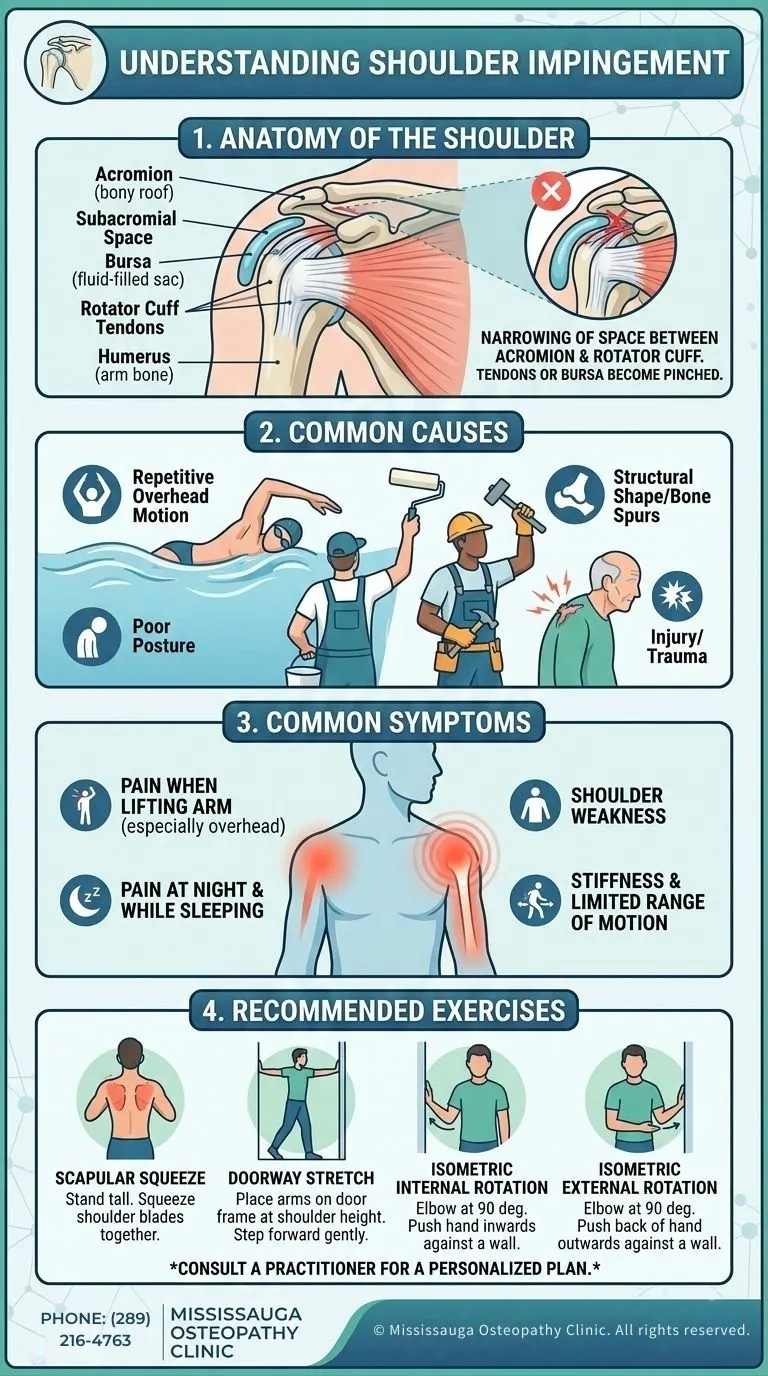
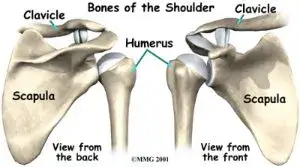
The shoulder joint is formed by three primary bones: the scapula (shoulder blade), the humerus (upper arm bone), and the clavicle (collarbone). Together they create a joint that allows lifting, rotating, and positioning of the arm in many directions.
A key structure in shoulder function is the rotator cuff, which connects the humerus to the scapula. The rotator cuff consists of four muscles and their tendons: the supraspinatus, infraspinatus, teres minor, and subscapularis. These muscles stabilize the shoulder and guide the arm through controlled movement.
Tendons attach muscles to bones, allowing muscles to move the skeleton by pulling on these attachments. In the shoulder, the rotator cuff tendons help lift the arm and rotate it outward and inward. As the arm moves upward, the rotator cuff also helps keep the humerus securely positioned in the socket of the scapula, called the glenoid.
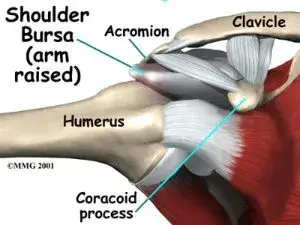
The top portion of the scapula forms the acromion, which acts as the roof of the shoulder. Between the acromion and the rotator cuff tendons lies a small lubricated sac known as a bursa. This structure reduces friction between the moving tissues, protecting the tendons and bone surfaces as the arm moves.

Causes
Normally there is adequate space between the acromion and the rotator cuff tendons, allowing the tendons to glide smoothly beneath the acromion when the arm lifts. However, each time the arm rises, a small amount of contact or compression occurs between these structures. This contact is known as impingement.
Mild impingement can occur in almost everyone during everyday movements. Activities that require raising the arms overhead—such as reaching, lifting, or throwing—can cause this temporary compression. In most cases, it does not lead to long-term problems. However, repetitive overhead movements or heavy use of the shoulder can gradually irritate the rotator cuff tendons.
Over time, this irritation may cause inflammation and swelling of the bursa and surrounding tissues. When swelling develops, the available space within the shoulder decreases, which can worsen the impingement.
Another factor that may contribute to shoulder impingement is the presence of bone spurs. These small bony projections can form due to wear and tear in the joint between the clavicle and the scapula, known as the acromioclavicular (AC) joint. Because this joint sits directly above the rotator cuff and bursa, bone spurs can narrow the space through which these tissues move.
In some individuals, the shape of the acromion itself contributes to the condition. If the acromion angles downward or has an unusual shape, it can naturally reduce the available space for the tendons beneath it.

Symptoms
Shoulder impingement often begins with a general aching sensation in the shoulder. During the early stages, discomfort may appear when lifting the arm to the side or reaching forward. As the condition progresses, pain may become more noticeable during daily activities.
Many individuals report that shoulder pain interferes with sleep, particularly when lying on the affected side. A sharp pain may also occur when reaching behind the body, such as when placing a hand in a back pocket.
As irritation continues, the joint may become stiff and difficult to move. Some people notice a catching or clicking sensation when lowering the arm. In more advanced cases, weakness may develop in the shoulder. Difficulty lifting the arm or performing overhead activities can sometimes indicate damage or tearing of the rotator cuff tendons.

Exercises
Targeted exercises may help strengthen the shoulder muscles and improve joint stability. One example involves using a resistance band.
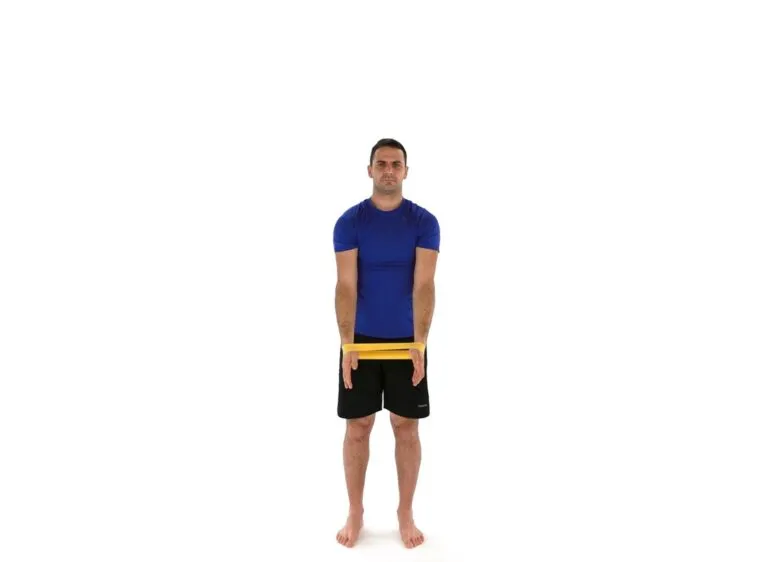
Place the resistance band around your wrists while keeping your elbows straight and your arms resting by your sides. Apply gentle tension to the band and rotate your thumbs outward at roughly a forty-five-degree angle. Maintain this tension as you slowly raise your arms overhead.
Throughout the movement, keep your spine neutral and avoid pushing your chin forward. Once your arms reach overhead, gradually lower them back to the starting position while maintaining control. Repeating this movement can help activate the muscles that stabilize the shoulder joint.

Our osteopathy services in Mississauga focuses on hands on care to restore movement, reduce pain, and improve physical function. Each session includes a full assessment of posture, mobility, and injury history to guide precise treatment. Care targets joint restriction, muscle tension, and circulation limits to support faster recovery and daily comfort. Services support injury recovery, chronic pain relief, postural correction, and long term physical balance.

Infants/Children and Youth Injuries
Infants, children, and youth injuries affect movement, posture, and development. Osteopathy focuses on gentle hands on care to address tissue tension, joint restriction, and movement imbalance for healthy growth and function.

Upper and Lower Back Pain Injury
Upper and lower back pain injury affects movement, posture, and daily activity. Osteopathy focuses on joint mobility, tissue tension, and movement balance to reduce strain and restore functional comfort.
About City Of Mississauga Ontario
Mississauga, Ontario, is a thriving city located along the shores of Lake Ontario, just west of Toronto. As one of Canada’s largest and fastest-growing cities, it is home to a diverse and multicultural population. With Pearson International Airport, the country’s busiest airport, and major corporate headquarters, Mississauga has established itself as a key business and economic hub in Canada. The city’s modern skyline, featuring high-rise condominiums and commercial developments, is complemented by green spaces, waterfront parks, and vibrant cultural attractions.
One of Mississauga’s most notable landmarks is Square One Shopping Centre, one of the largest malls in Canada, attracting millions of visitors each year. The downtown core is rapidly evolving, with new residential and commercial projects reshaping the city’s landscape. Meanwhile, neighborhoods like Port Credit offer a charming, lakefront lifestyle with boutique shops, cafes, and marinas, making it a popular destination for both residents and tourists. Historic Streetsville, with its small-town charm, provides a glimpse into Mississauga’s past while offering modern amenities.


Mississauga is also a city committed to education and innovation, with top-rated schools, colleges, and easy access to leading universities in the Greater Toronto Area. The city’s public transit system is expanding, with new LRT and GO Transit projects aiming to enhance connectivity and reduce congestion. With a strong focus on community development and sustainability, Mississauga continues to improve its infrastructure, recreational spaces, and public services to meet the needs of its growing population.
Beyond its economic success, Mississauga is a welcoming and family-friendly city with a strong sense of community. The city hosts numerous cultural festivals, outdoor events, and recreational activities, celebrating its diverse population. Whether enjoying waterfront trails in Lakeview, exploring Erin Mills and Meadowvale’s parks, or experiencing arts and performances at the Living Arts Centre, Mississauga offers something for everyone. With its blend of urban convenience and suburban comfort, it remains a top choice for those looking to live, work, and thrive in a dynamic and inclusive environment.
- Hurontario St
- Dundas St
- Eglinton Ave
- Burnhamthorpe Rd
- Lakeshore Rd
- Britannia Rd
- Matheson Blvd
- Mavis Rd
- Dixie Rd
- Winston Churchill Blvd
- Queensway
- Cawthra Rd
- Erin Mills Pkwy
- Derry Rd
Central Mississauga
- L4Z,
- L5B,
- L5C
North Mississauga
- L5N
- L5M
- L5V
- L4Z
- L5R
West Mississauga
- L5L
- L5M
East Mississauga
- L4W
- L4X
- L4Y
- L4Z
- L5A
South Mississauga
- L5G
- L5H
- L5J
- L5K
- L5E
References
Cleveland Clinic – Shoulder Impingement Syndrome (Rotator Cuff Tendinitis) https://my.clevelandclinic.org/health/diseases/shoulder-impingement-rotator-cuff-tendinitis
American Academy of Orthopaedic Surgeons – Shoulder Impingement/Rotator Cuff Tendinitis https://orthoinfo.aaos.org/en/diseases–conditions/shoulder-impingementrotator-cuff-tendinitis/
StatPearls (NCBI Bookshelf) – Shoulder Impingement Syndrome https://www.ncbi.nlm.nih.gov/books/NBK554518/
Canada Life. (2025, November 6). What is osteopathy? Canada Life. https://www.canadalife.com/insurance/health-and-dental-insurance/what-is-osteopathy.html
BOOK AN APPOINTMENT WITH US